

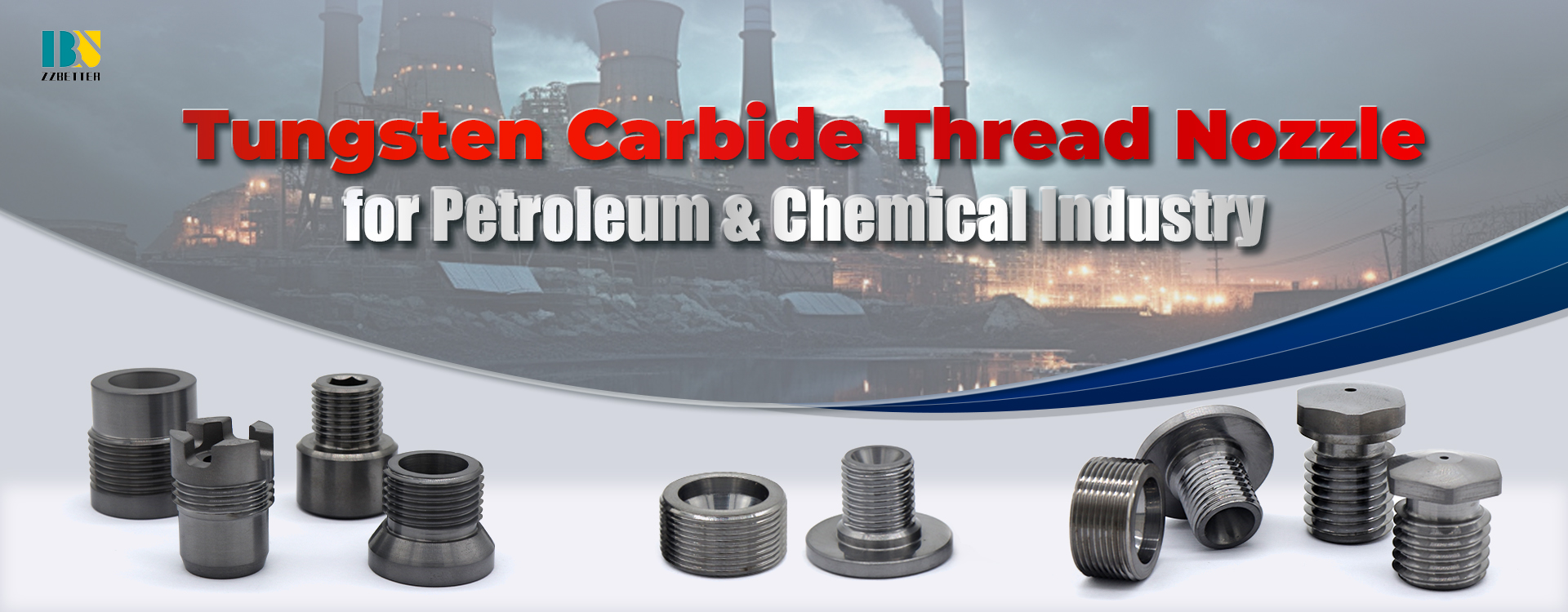
Ugello à filettatura in carburu di tungstenu per l'industria petrolifera è chimica

Ugello à filettatura in carburu di tungstenu per l'industria petrolifera è chimica
Introduzione
In l'industria petrolifera è chimica, a durabilità di l'equipaggiu in cundizioni estremi - cum'è u flussu di fluidu d'alta pressione, particelle abrasive è ambienti corrosivi - hè critica. L'ugelli di filettatu di carburu di tungstenu (WC) sò emersi cum'è una soluzione superiore, chì offre una resistenza à l'usura, resistenza à a corrosione è forza meccanica ineguagliabile in paragunà à i materiali tradiziunali cum'è l'acciaio inox o a ceramica. Questu articulu esplora u disignu, i benefici, a fabricazione è l'applicazioni di ugelli di filu di carburu di tungstenu in i settori di petroliu, gasu è chimicu.
1. Cosa hè un Nozzle Carbide Tungsten Thread?
Una bocca di filu hè un cumpunente di precisione ingegneria utilizatu in sistemi di cuntrollu di fluidu per regulà a direzzione di u flussu, a pressione è a velocità. Quandu sò custruiti da carburu di tungstenu, questi ugelli mostranu una durezza eccezziunale (1,400-2,200 HV) è una durabilità, chì li facenu ideali per ambienti industriali duri.
Funzioni chjave:
✔ Resistenza ultra-alta à l'usura - Resiste à e particelle abrasive in u fangu di perforazione è i fluidi carichi di sabbia.
✔ Resistenza à a Corrusione - Eseguisce in cundizioni acidi (H₂S/CO₂) è alkaline.
✔ Stabilità à alta temperatura - Mantene l'integrità strutturale finu à 1.000 ° C.
✔ Disegnu filettatu - Assicura un adattamentu sicuru in pipeline à alta pressione.
2. Applicazioni in Petroleum & Chemical Industries
2.1 Oil & Gas Drilling
- Ugelli di cuntrollu di sabbia: Aduprati in sistemi di pacchettu di ghiaia per filtrà a sabbia mentre mantene u flussu.
- Ugelli a getto di fango: dirige il fluido di perforazione ad alta velocità per pulire i pozzi.
- Frattura idraulica (Fracking): Resiste à l'erosione da i fluidi caricati di proppant.
2.2 Refining & Petrochemical Processing
- Ugelli di iniezione di catalizzatore: Impedisce l'usura in unità FCC (Fluid Catalytic Cracking).
- Ugelli di spruzzo di desulfurizazione: resiste à l'esposizione à l'acidu sulfuricu.
2.3 Chemical & Power Plants
- Ugelli di Pulizia di Alta Pressione: Aduprati in a pulizia di i tubi di a caldaia.
- Dispersione di fluidi corrosivi: resiste à l'attaccu chimicu in i sistemi di trasferimentu d'acidu / alkali.
3. Perchè Tungsten Carbide Outperforms Traditional Materials?
Propriété Carbure de tungstène Acier inoxydable (316L) Ceramique (Al₂O₃)
Durezza (HV) 1.400–2.200 200–300 1.500–1.800
Resistenza à l'impattu Alta Moderata Bassu (fragile)
Resistenza à a corrosione Eccellente (WC-Ni) Moderata (Pitting) Povera (HF/NaOH)
Temperature Max (°C) 1.000 800 1.600 (Subpensive à u scossa termica)
Vantaggi:
- Durata di vita 5-10 volte più longa cà ugelli d'acciaio in cundizioni abrasive.
- Riduce i tempi di inattività minimizendu a sostituzione di ugelli.
- Precisione di flussu più altu per via di a deformazione minima indutta da l'erosione.
4. Prucessu Manufacturing di WC Thread Nozzles
4.1 Metallurgia di Polveri
1. Powder Mixing: WC powder + Co / Ni binder (6-12%).
2. Pressing: Cold isostatic pressing (CIP) per a densità uniforme.
3. Sinterizzazione: Sinterizzazione di vacuum à 1.400-1.500 ° C per a densificazione completa.
4.2 Machining & Threading
- Rettifica: Rettifica a rota di diamante per tolleranze di precisione (± 0,01 mm).
- Taglio di filettatura: lavorazione CNC per filettature conformi API/ISO.
4.3 Controlu di qualità
- Test Ultrasonic: Detecta crepe interne.
- Ispezione dimensionale: verificazione CMM (Coordinate Measuring Machine).
- Cuntrolli di durezza è di densità: assicura ≥99,5% densità teorica.
5. Case Study: WC Nozzle in Offshore Drilling
Prublemu: Un operatore di u Mari di u Nordu hà affruntatu frequenti fallimenti di l'ugelli per via di l'erosione di sabbia (sustituzione ogni 2 settimane).
Soluzione: Cambiatu à ugelli filettati WC-13Co.
Risultatu:
✔ A vita di serviziu allargata à 6+ mesi
✔ Costi di mantenimentu ridotti di 70%
6. Future Trends & Innovations
- WC Nano-Grained: Resistenza aumentata per applicazioni ultra-alta pressione.
- Ugelli stampati in 3D: Geometrie interne cumplesse per una dinamica fluida ottimizzata.
- Ugelli intelligenti cù Sensori IoT: Monitoraghju di l'erosione in tempu reale.
Cunclusioni
L'ugelli di filettatu di carburu di tungstenu rivoluzionanu a manipulazione di fluidi in l'industria petrolifera è chimica offrendu una durabilità, resistenza à a corrosione è precisione senza pari. Cume a tecnulugia avanza, ugelli WC nanostrutturati è intelligenti aumenteranu ancu l'efficienza è riducenu i costi operativi.
Interessatu à aghjurnà i vostri sistemi di ugelli? Cuntattate u nostru squadra di ingegneria per una suluzione persunalizata!
Referenze:
1. API 6A - Wellhead & Christmas Tree Equipment Standards
2. ASTM B777 - Specificazione per i Nozzles Carbide di Tungsten
3. Meccanismi di Wear in Alloys Duri (Journal of Materials Engineering)