

"Dedicated Tooth Profiles" of Solid Carbide Circular Saw Blades for Cutting Different Materials

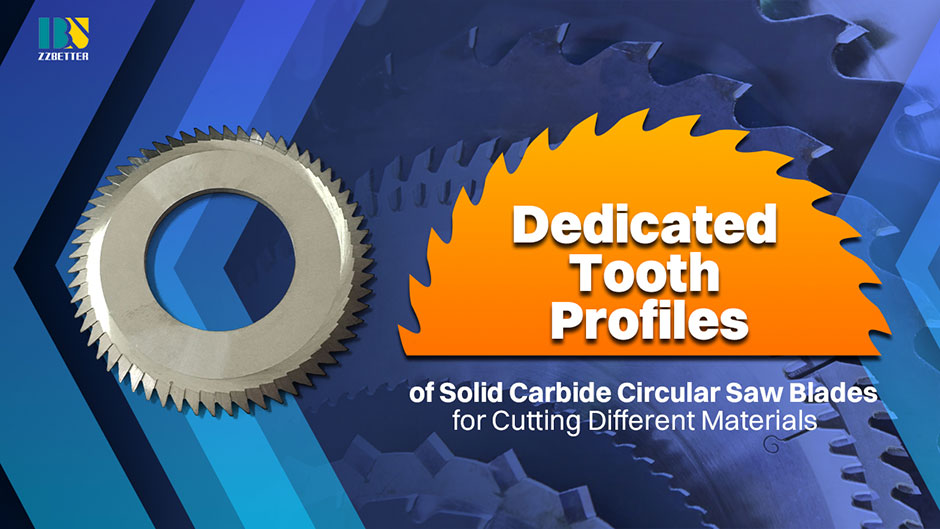
In the field of modern precision machining, solid tungsten carbide round saw blades have become the preferred tool for high-precision cutting tasks due to their excellent rigidity and wear resistance. However, when faced with diverse workpiece materials, a single tooth profile cannot achieve optimal machining results. Developing corresponding "dedicated tooth profiles" based on the physical characteristics and processing requirements of different materials is key to improving cutting quality and efficiency.
I. Theoretical Basis for Dedicated Tooth Profile Design
Tooth profile design essentially involves precise control of the cutting process, requiring consideration of the following key factors:
1. Material Fracture Mechanism: Different materials exhibit varying fracture behaviors during cutting.
2. Chip Morphology Control: A reasonable tooth profile helps form ideal chip shapes.
3. Thermal Management: Optimizing the tooth profile to control cutting temperature.
4. Cutting Force Distribution: Ensuring stable cutting forces and avoiding vibration.
II. Dedicated Tooth Profile Design Solutions for Different Materials
1. Tooth Profile Dedicated to Carbon Fiber Reinforced Polymers (CFRP)
Tooth Profile Characteristics:
Small rake angle (0°-5°) design to enhance edge strength.
High tooth density ensures uniform feed per tooth.
Special edge treatment achieves clean cutting of the material.
Design Principle:
CFRP is anisotropic and highly abrasive, requiring sharp cutting edges to reduce delamination and burrs. The small rake angle effectively prevents material tearing, and the high tooth count ensures fibers are cut neatly during the process.
2. Tooth Profile Dedicated to Aluminum Alloys
Tooth Profile Characteristics:
· Large rake angle (15°-20°) design ensures cutting sharpness.
· Variable pitch design effectively suppresses vibration.
· Polished chip gullets reduce chip adhesion.
Design Principle:
Aluminum alloy is relatively soft and prone to built-up edge. The large rake angle ensures smooth and easy cutting, the variable pitch disrupts vibration frequencies, and the polished surface prevents aluminum chip accumulation.
3. Tooth Profile Dedicated to Stainless Steel
Tooth Profile Characteristics:
· Medium rake angle (5°-10°) design balances sharpness and strength.
· Reinforced tooth root design improves structural stability.
· Special chip gullet geometry ensures smooth chip evacuation.
Design Principle:
Stainless steel has a significant work hardening tendency, requiring a strong cutting edge and good chip evacuation. The medium rake angle provides sufficient support while maintaining sharpness, and the reinforced tooth root handles higher cutting forces.
4. Tooth Profile Dedicated to Copper and Copper Alloys
Tooth Profile Characteristics:
· Sharp cutting edge with a rake angle of 10°-15°.
· Special chip space design.
· Smooth surface finish.
Design Principle:
Copper has good thermal conductivity but is prone to burr formation. The sharp cutting edge ensures a clean cut, and the special chip space design prevents material adhesion.
III. Key Technical Parameters for Tooth Profile Optimization
1. Rake Angle Selection:
· Soft Materials: Large rake angle (15°-25°)
· Medium Hardness Materials: Medium rake angle (5°-15°)
· Hard and Brittle Materials: Small rake angle (0°-5°)
2. Tooth Count Determination:
· Thin-walled Materials: High tooth count
· Thick-walled Materials: Low tooth count
· High Surface Finish Requirements: High tooth count
3. Tooth Pitch Design:
· Constant Pitch: General-purpose machining
· Variable Pitch: Applications requiring high vibration damping
IV. Case Study of Practical Application
An aerospace company frequently encountered issues like delamination and burrs when using a general-purpose tooth profile blade to cut CFRP. After switching to a dedicated tooth profile blade:
· Machining efficiency increased by 40%.
· Product qualification rate improved from 85% to 98%.
· Tool life extended by 3 times.
V. Future Development Trends
1. Intelligent Tooth Profile Design: Tooth profile optimization based on artificial intelligence.
2. Development of Composite Tooth Profiles: Adapting to the machining of material mixtures.
3. Micro-textured Tooth Profiles: Adding micro-structures to the tooth surface to improve cutting performance.
The "dedicated tooth profile" design of tungsten carbide circular saw knife is crucial for improving machining quality. By deeply understanding material characteristics and combining them with scientific optimization of tooth profile parameters, machining efficiency can be significantly enhanced, surface quality improved, and tool life extended. In the future, with the continuous emergence of new materials and increasingly stringent machining requirements, the development of dedicated tooth profiles will move towards greater refinement and intelligence, providing superior cutting solutions for the manufacturing industry.