

CBN Inserts Competitor Analysis: User Experience & Product Design

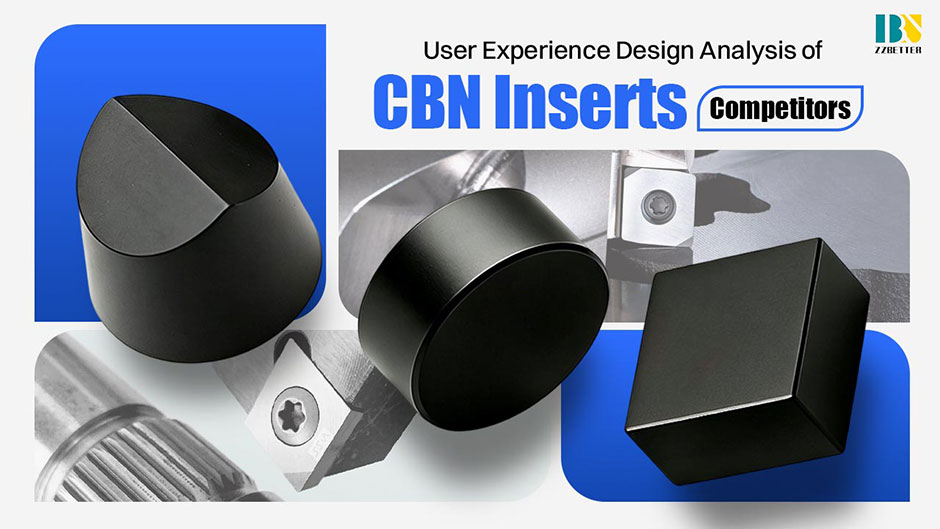
In the field of high-hardness material processing, the user experience of CBN inserts is directly related to production efficiency and machining accuracy. Leading brands build core competitiveness through differentiated designs. Based on the five-element framework of user experience, this article conducts an in-depth analysis of CBN inserts from brands such as Tungaloy, Sandvik, Kyocera, and domestic brand Zhuzhou, providing references for industry selection and product optimization.
There are significant differences in strategic positioning. Tungaloy focuses on "high-precision automated machining". Its TCX series CBN inserts are specially designed for gear, shaft, and other hardened steel components, equipped with 3D chip breaker technology, accurately matching the needs of unmanned production lines and targeting high-end automotive manufacturing scenarios. Sandvik, on the other hand, focuses on "efficient integrated machining". Its inserts with integral chip breakers adopt a one-time cutting strategy, with a maximum cutting depth of 2mm, which can eliminate multiple cutting processes and adapt to the integrated hard-soft machining needs of transmission parts. Kyocera and Zhuzhou focus more on "cost-effectiveness and versatility", covering multi-scenario machining from ordinary hardened steel to mold steel, and meeting the needs of small and medium-sized manufacturing enterprises with standardized models.
Functional design has its own focuses. The 3D chip breaker of the Tungaloy TCX series has excellent chip removal performance, which can effectively prevent chip winding. Combined with the four-corner insert design, it achieves a balance between cost and efficiency, and its unique 1mm narrow-width model fills the gap in the field of ultra-fine grooving. Sandvik inserts ensure the generation of short chips through the parallel design of long tool tips and chip breakers, reducing machining interruptions caused by chip clogging and improving continuous operation stability. Kyocera's KBN series adopts coating technology; for example, the KBN10M model has both high hardness and chipping resistance, suitable for high-speed continuous machining. Zhuzhou's YCB series optimizes the matrix toughness design to reduce the risk of chipping during intermittent cutting.
The performance at the experience level is obviously differentiated. High-end brands have outstanding advantages in precision control. Tungaloy inserts have high cutting edge positioning accuracy, which can reduce tool deflection. Sandvik products have a surface roughness of up to Ra0.28μm, meeting the needs of precision machining. Domestic inserts are gradually catching up in durability, and the durability of some models has reached twice that of imported brands, but there is still a gap in stability during high-speed machining. In addition, Kyocera provides single-insert packaging, suitable for small-batch trial production needs; while Tungaloy adopts a 2-piece packaging design, which is more in line with inventory management habits for large-scale production.
In summary, high-end brands build experience barriers through scenario-based technological innovation, while domestic brands seize the market with cost-effectiveness and versatility. The future direction of experience optimization for CBN inserts should focus on the versatility of chip breakers, coating wear resistance, and model standardization, taking into account the needs of automated machining and cost control for small and medium-sized users, so as to achieve a balance between precision, efficiency and economy.