

Political Environment of CBN Inserts: Policies, Trade and Risks

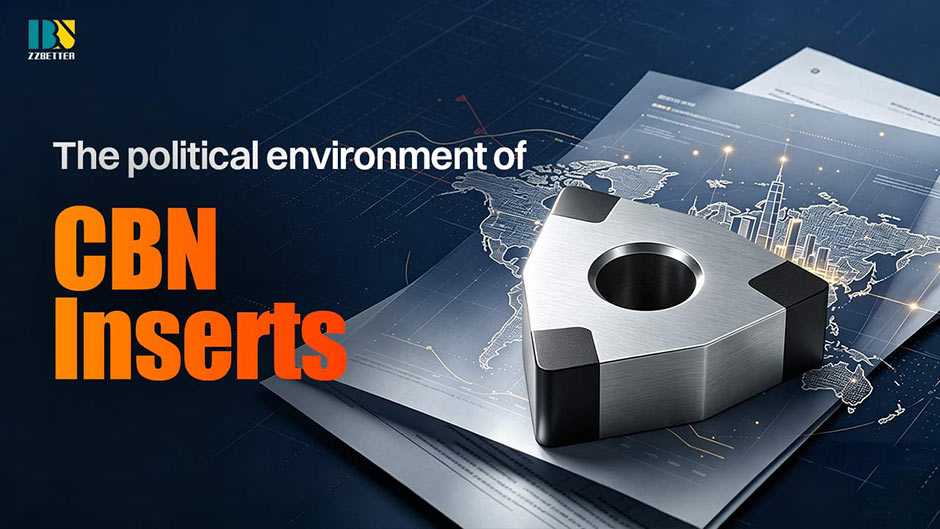 The political environment of CBN inserts is characterized by the coexistence of policy support and tightening control, with intertwined risks and opportunities. A detailed analysis of key aspects is as follows:
1. Domestic Export Control Policies: As strategic materials, superhard materials including CBN inserts have been incorporated into the core export control system. In accordance with Announcement No. 55 of 2025 jointly issued by the Ministry of Commerce and the General Administration of Customs, the control covers the entire industrial chain from CBN production equipment and core process technologies to dual-use end products. Enterprises must apply for export licenses for relevant products and clearly indicate item attributes and control codes in customs declarations; failure to obtain licenses or making false declarations may result in risks such as cargo detention.
2. Domestic Industrial Support Policies: The government strongly promotes the localization substitution of high-end CBN inserts. Specific measures include setting up special R&D funds to support the tackling of "chokepoint" technologies, and providing financial subsidies to enterprises adopting domestic components. These policies encourage cooperation between enterprises and scientific research institutions, helping enhance the independent controllability of the industrial chain and drive high-quality industry development.
3.EU Trade and Environmental Barriers: The transition period of the EU's Carbon Border Adjustment Mechanism (CBAM) will end at the end of 2025, and formal carbon tariffs will be imposed on imported mechanical equipment including CBN inserts from 2026. Enterprises are required to accurately declare product carbon footprint data; over-reliance on default values (which will be increased by 10% in 2026) may weaken international competitiveness. Only small and medium-sized enterprises with an annual import volume of less than 50 tons are eligible for exemption.
4. U.S. Technological Blockades and Trade Restrictions: The U.S. has strengthened technological blockades through measures such as entity list controls and tariff increases, incorporating many superhard material-related enterprises into the export control list. This restricts the import and export of high-end CBN inserts and related technologies, bringing significant challenges to enterprises' market expansion in the U.S.
5. Opportunities from Regional Trade Agreements: Under the framework of regional trade agreements such as RCEP, tariff reduction policies in the Asia-Pacific market have significantly reduced the export costs of CBN inserts. This provides favorable conditions for enterprises to expand emerging markets and optimize their international market layout.
6. Geopolitical Risks to Supply Chains: The intensification of global geopolitical games has increased the pressure on the restructuring of the CBN insert supply chain. The cross-border circulation of core raw materials and production equipment has become more uncertain, forcing enterprises to balance supply chain security and operational efficiency through diversified layout strategies.
7. Domestic Green Manufacturing and Work Safety Supervision: Relevant policies have been continuously tightened, requiring enterprises to optimize production processes to reduce energy consumption and emissions. Strict work safety supervision is also implemented for high-temperature and high-pressure production processes of CBN inserts, urging enterprises to improve safety management systems and promote the industry's transformation towards sustainability.