

Coating Technologies for Solid Carbide Saw Blades: Applications and Selection

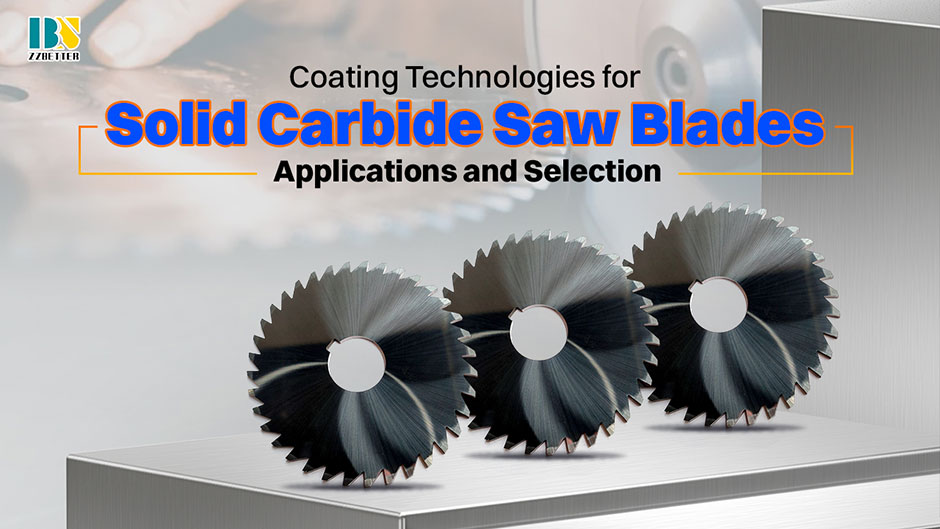
In modern precision machining, solid tungsten carbide saw blades have become core tools for demanding applications due to their high rigidity, accuracy, and long service life. However, with the widespread use of difficult-to-machine materials (such as carbon fiber composites, high-temperature alloys, and high-silicon aluminum alloys), the plain carbide substrate alone can no longer meet all challenges. Coating technology, as a key method to enhance blade performance, significantly improves wear resistance, lubricity, and thermal stability by depositing a few microns of super-hard thin film on the substrate surface, thereby multiplying processing efficiency and service life. Among them, TiN (Titanium Nitride), TiAlN (Titanium Aluminum Nitride), and DLC (Diamond-Like Carbon) are three of the most representative mainstream coatings. Understanding their characteristics and making correct selections is crucial for maximizing the potential of solid carbide saw blades.
I. Core Functions of Coating Technology: Beyond "Just a Layer"
Coatings are not simple physical barriers; they enhance blade performance through multiple synergistic mechanisms:
1. Increased Surface Hardness and Wear Resistance: Coating materials typically have much higher hardness (e.g., DLC coating hardness can reach 3000-5000 HV) than carbide, effectively resisting abrasive wear. This serves as the first line of defense for protecting the substrate, especially when cutting highly abrasive materials like fiberglass and carbon fiber.
2. Enhanced Thermal Stability and Oxidation Resistance: Under the high temperatures generated by high-speed dry cutting, the coating effectively blocks heat transfer to the substrate and prevents oxidation of the substrate material at high temperatures, maintaining cutting edge strength stability.
3. Reduced Friction Coefficient and Improved Chip Evacuation: Coated surfaces typically have a low friction coefficient, reducing cutting heat, suppressing built-up edge formation, and promoting rapid chip removal. This is crucial for preventing material adhesion when machining sticky materials like aluminum alloys.
4. Chemical Inertness: Some coatings offer excellent chemical stability, reducing the tendency to react with the workpiece material.
II. In-Depth Analysis of Three Mainstream Coatings
1. TiN (Titanium Nitride) – The Classic All-Rounder
- Characteristics: Displays a classic golden color. Hardness is approximately 2300 HV, with a moderate friction coefficient and good overall wear resistance and strong adhesion.
- Advantages: Mature technology and high cost-effectiveness. It significantly improves the machining performance of ordinary steels, alloy steels, and non-ferrous metals, potentially increasing tool life by 3-5 times compared to uncoated blades.
- Limitations: Relatively low heat resistance (about 600°C). Performance degrades rapidly under high temperatures generated by high-speed or dry cutting. Offers less advantage for highly abrasive materials.
- Ideal Applications: Primarily used for general-purpose machining, such as cutting low-carbon steel, stainless steel, titanium alloys, as well as copper and aluminum. It is a cost-effective entry-level high-performance coating choice.
2. TiAlN (Titanium Aluminum Nitride) – The Champion for High-Temperature Machining
- Characteristics: Appears purplish-black or dark blue. The introduction of aluminum into TiN leads to a qualitative leap in performance.
- Advantages: Its core advantage is high-temperature stability. At cutting high temperatures (up to 800-900°C), a dense, inert aluminum oxide (Al₂O₃) protective layer forms on the coating surface. This layer acts as a "thermal barrier," effectively blocking heat. This makes it excel in demanding conditions like high-speed dry cutting and interrupted cuts.
- Limitations: Hardness is similar to TiN, but its high-temperature performance is the key highlight. Cost is higher than TiN.
- Ideal Applications: The ideal choice for machining high-strength steels, high-temperature alloys, nickel-based alloys, and for high-speed dry cutting (e.g., mold steel machining). Its performance far exceeds TiN when cutting hardened, high-hardness materials.
3. DLC (Diamond-Like Carbon) – The Specialist for Non-Ferrous Metals
- Characteristics: Typically has a mysterious gray-black or black sheen. DLC coatings contain sp³ bonds (diamond structure), giving them both high hardness (up to 5000 HV) and an extremely low friction coefficient (0.1-0.2, close to Teflon).
- Advantages: Excellent anti-friction and anti-adhesion properties. When machining non-ferrous metals like aluminum, copper, magnesium, and their alloys, it fundamentally solves problems of material sticking and built-up edge, thereby achieving very high surface finish. Its high hardness also provides good wear resistance.
- Limitations: Thermal stability is its main weakness. When temperatures exceed 300-400°C, sp³ bonds can transform into sp² bonds (graphite structure), causing coating failure and hardness reduction. Furthermore, it has high chemical affinity with ferrous materials, hence it is not suitable for machining iron-based materials like steels.
- Ideal Applications: Specifically designed for sticky and abrasive non-ferrous materials like aluminum alloys, copper alloys, graphite, and plastics, including high-silicon aluminum. In the electronics industry for aluminum housing machining or automotive engine aluminum component processing, DLC-coated blades are the ultimate solution for achieving high-gloss, burr-free cuts.
Coating technology provides the wings for the performance leap of solid carbide saw blades. TiN, TiAlN, and DLC represent three major technological paths: general-purpose wear resistance, high-temperature protection, and friction reduction/anti-adhesion, respectively. In practice, decision-makers need to thoroughly analyze the characteristics of their primary workpiece materials: Do they generate high heat? Are they prone to sticking? Or are they extremely abrasive? Based on this, selecting the most compatible coating allows for the perfect integration of the rigidity and precision of the solid carbide blade with the surface enhancement advantages of the coating. Ultimately, this synergy achieves a "1+1 > 2" effect in improving machining efficiency, extending tool life, and ensuring product quality. In this sense, correct coating selection is the critical step from "good" to "excellent" in precision cutting.