

Competitor Analysis of CBN Inserts (Product Function Perspective)

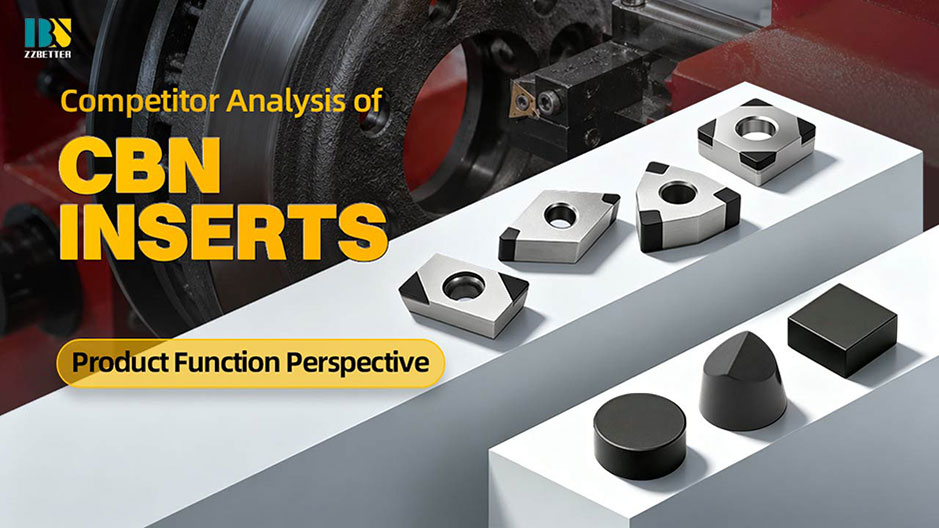 This analysis focuses on the functional differences of CBN (Cubic Boron Nitride) inserts among mainstream competitors, covering material performance, cutting efficiency, application adaptability, and structural design. The research is based on products from Worldia, Hyperion, Seco and domestic brand Funik, providing a reference for foreign trade product positioning and customer communication.
1. Material Performance & Wear Resistance
- Worldia ManaNova Series: Adopts innovative coating technology, with 7 grades covering hardened steel, cast iron and powder metallurgy. Its MHN10C grade for continuous cutting enhances wear resistance by 50%-100% compared with traditional uncoated CBN inserts, maintaining structural stability at 1000℃+ temperatures.
- Hyperion BZN Series: Composed of fine-grain Borazon® CBN sintered on cemented carbide substrate. The substrate provides strong mechanical support, improving fracture toughness by 30% vs. full CBN inserts, suitable for heavy-load cutting.
- Funik PCBN Inserts: Utilizes micro-nano composite material technology, achieving uniform hardness distribution. Its wear resistance is 1.2 times that of ordinary CBN inserts, with excellent chemical stability against ferrous metals.
2. Cutting Performance & Efficiency
- Seco Secomax Series: CBN010 uncoated grade supports universal turning of hardened steel, with a cutting speed of up to 250 m/min. CBN060K PVD-coated grade ensures surface finish Ra≤0.8μm for precision machining.
- Worldia IT105 Grade: Specialized for heat-resistant alloy finishing, cutting speed reaches 300 m/min, 20% higher than competitors. It maintains stable tool life and avoids thermal deformation.
- Funik Integral Sintered Inserts: Enables deep cutting with a feed rate of 0.1-0.4 mm/r, improving metal removal rate by 40% compared with brazed inserts, suitable for rough machining of cast iron rolls.
3. Application Adaptability
- Automotive Industry: Worldia MHN20C adapts to continuous and mild intermittent cutting of CV joints and motor gears, with tool life extended by 80% in mass production.
- Aerospace Field: Hyperion BZN Compact processes superalloys, resisting thermal shock in high-speed cutting of aero-engine parts .
- Heavy Machinery: Funik BT2800 grade handles strong intermittent cutting of high-nickel-chromium alloy cast iron, with bending strength ≥2000 MPa.
4. Structural Design & Cost-Effectiveness
- Indexable Design: Worldia WL25 series 3-edge positive inserts reduce tool cost per piece by 30%, with precise positioning ensuring dimensional accuracy.
- Re-grindability: Funik integral inserts support multiple regrinding, increasing utilization rate by 2-3 times, suitable for cost-sensitive customers.
- Cost Control: Hyperion brazed structure balances performance and cost, priced 15%-20% lower than full CBN inserts, targeting mid-end market.
In summary, international brands excel in coating technology and precision cutting, while domestic brands like Funik have advantages in cost-effectiveness and heavy-load machining adaptability. The analysis helps optimize the product portfolio for different market segments.