

Precision Design of Cutting Geometry in Solid Tungsten Carbide Saw Blades

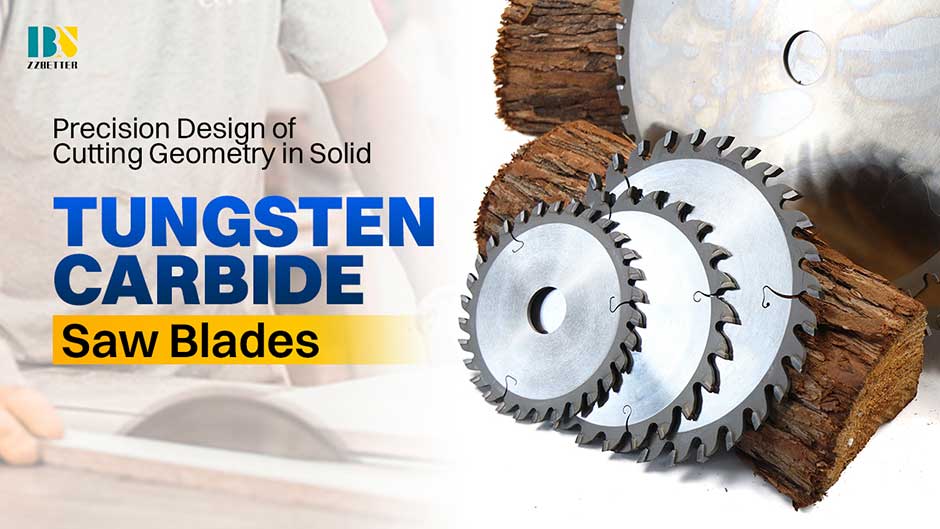
In modern precision machining, solid tungsten carbide saw blades have become core tools for high-precision cutting tasks. Their exceptional cutting performance stems not only from premium carbide materials but, more importantly, from the precision design of their cutting geometry. The rake angle, clearance angle, and wedge angle - as the three core elements of cutting geometry - collectively form the "soul" of the saw blade, directly determining cutting force magnitude, chip formation, processing quality, and tool lifespan. The scientific optimization and balance of these angles are crucial for achieving efficient, precise, and stable machining.
I. Rake Angle: The "Guide" of the Cutting Process
The rake angle, formed between the tooth's front face and the radial line of the blade body, primarily influences cutting efficiency and force.
• Positive Rake Angle Design: Increasing the rake angle makes the teeth sharper, enabling easier material penetration with reduced cutting force. This design significantly decreases cutting resistance and power consumption while effectively suppressing heat generation. Particularly suitable for soft non-ferrous metals (like aluminum, copper), plastics, and other ductile materials, it produces exceptionally smooth cut surfaces.
• Negative Rake Angle Design: Negative rake angles enhance edge strength, allowing the teeth to withstand greater impact loads. When processing high-hardness or highly abrasive materials (such as carbon fiber composites, high-silicon aluminum alloys), negative rake angles effectively protect the cutting edge from chipping and premature wear. Although cutting forces increase correspondingly, tool stability and lifespan improve significantly.
- Precision Consideration: The selection of rake angle isn't about choosing the largest or smallest value, but finding the optimal balance between "sharpness" and "strength." For instance, when cutting aluminum alloy prone to material adhesion, a moderate positive rake angle combined with a smooth rake face is key to achieving perfect chip breaking.
II. Clearance Angle: The "Protector" Against Friction
The clearance angle, formed between the tooth's flank and the machined surface, primarily functions to reduce friction between the tooth flank and workpiece.
• Friction Control and Surface Quality**: Adequate clearance angle ensures the tooth flank doesn't generate excessive friction with the cut surface. Insufficient clearance angle leads to increased friction, generating substantial heat that can cause workpiece surface burning, work hardening, and rapid tool dulling.
• Balance Between Edge Strength and Heat Dissipation: However, larger clearance angles aren't always better. Excessive clearance angle reduces the supporting volume of the cutting edge and compromises heat dissipation capacity, potentially leading to chipping and premature failure. Particularly when cutting high-strength materials, a moderate and stable clearance angle is essential to balance friction control and edge robustness.
- Precision Consideration: Different materials require differentiated clearance angle designs. When cutting soft, sticky materials, slightly larger clearance angles prevent material adhesion; while processing hard, brittle materials, slightly smaller clearance angles provide better support.
III. Wedge Angle: The "Foundation" of Edge Strength
The wedge angle isn't independently machined but derived from the combination of rake and clearance angles (Wedge Angle = 90° - Rake Angle - Clearance Angle). It directly reflects the inherent robustness of the cutting edge.
• Core Support Function: The wedge angle directly represents edge strength. A larger wedge angle means thicker edge support, capable of withstanding higher cutting forces and impacts, demonstrating excellent resistance to chipping - ideal for heavy-duty roughing and interrupted cuts.
• Constraint on Sharpness**: Conversely, a smaller wedge angle creates a very sharp edge with smooth cutting action, but at the cost of some edge strength. This design is primarily used for finishing operations and situations with strict cutting force limitations.
- Precision Consideration: Wedge angle design essentially represents the compromise between rake and clearance angles. The designer's core task is to calculate the optimal wedge angle range that simultaneously meets both sharpness requirements and durability needs based on the physical properties of the target material (whether tough titanium alloy or brittle graphite).
Angle Synergy: A Systematic Design Philosophy
In practical applications, these three angles must be designed and optimized as an integrated system due to their close interrelationships:
• Changing rake angle inevitably affects wedge angle: Increasing rake angle to pursue extreme sharpness will reduce the wedge angle without compensatory design, potentially compromising edge strength.
• Collaborative optimization strategy: For example, when designing a blade for cutting carbon fiber composites, one might employ a moderate positive rake angle to ensure clean penetration, while matching it with a slightly reduced clearance angle to guarantee adequate edge support and heat dissipation - ultimately forming a reasonable and robust wedge angle that ensures cutting quality while effectively handling carbon fiber's high abrasiveness.
The precision design of cutting geometry in solid carbide saw knives is both a profound science and an exquisite art. It demands designers to deeply understand the inherent principles of materials science, cutting mechanics, and tribology. Through precise definition and synergistic optimization of rake angle, clearance angle, and wedge angle, we can "customize" perfect saw blades specifically tailored for particular materials and processes. In today's era of high-end manufacturing that pursues ultimate efficiency and quality, this precision angle-based design represents the core technology that transforms a quality carbide blank into a "divine tool" capable of conquering the most challenging machining tasks.