

How to Choose Between Rotary Burrs and Carbide End Mills

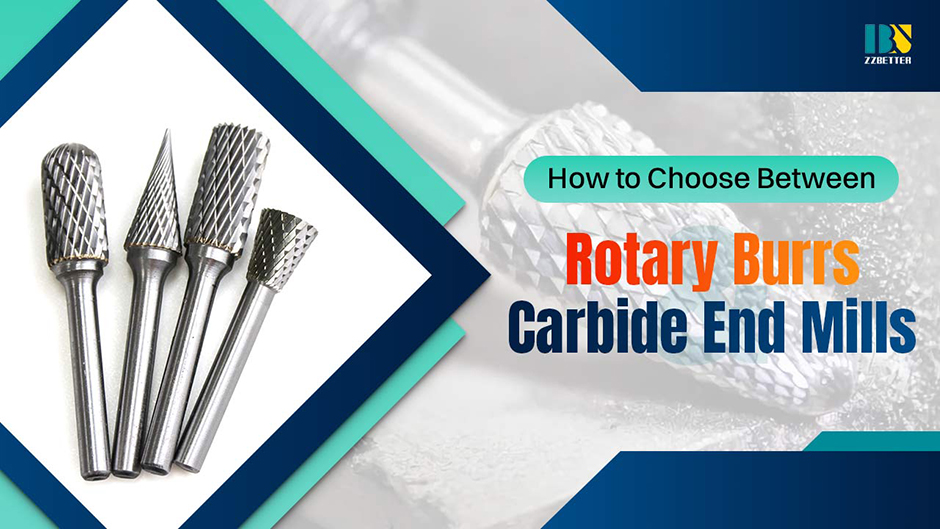
Within the family of carbide tools, rotary burrs and carbide end mills are two crucial members. They may look similar and are both renowned for their exceptional hardness, wear resistance, and long service life. However, users unfamiliar with them often confuse their applications. This article will provide an in-depth comparison of these two tools to help you make the most informed choice based on your specific processing needs.
I. Core Definitions and Alternative Names
Carbide Rotary Burrs: Often referred to as "carbide grinding heads" or "die grinder bits." They typically consist of a carbide head and a steel shank. The head comes in various shapes (e.g., spherical, cylindrical, tree-shaped) and is covered with cutting teeth. In essence, they are grinding tools.
Carbide End Mills: These are standard cutting tools. The tool body is made from solid carbide or features indexable carbide inserts. They have sharp cutting edges with specific geometries and are designed for precise material removal on machine tools.
II. Key Differences and Application Scenarios
1. Processing Method: Manual Finishing vs. Machine-based Automated Cutting
· Rotary Burrs: Primarily used with hand-held tools like electric grinders or pneumatic die grinders. They rely on the operator's manual control and are suitable for tasks like shaping freeform surfaces, polishing, deburring, and chamfering. Their advantage lies in flexibility and accessibility, allowing them to handle complex contours and narrow spaces.
· Carbide End Mills: Must be mounted on CNC milling machines, machining centers, or manual milling machines, where their movement is precisely controlled by a program or mechanical means. They are designed for efficient, high-volume, and high-precision tasks like milling flat surfaces, cavities, and profiles.
2. Processing Outcome: Shaping & Finishing vs. Efficiency & Precision
· Rotary Burrs: Remove material through a "grinding" action. They can achieve a good surface finish, but the machining accuracy heavily depends on the operator's skill level. They are more suited for semi-finishing and finishing stages.
· Carbide End Mills: Remove material through a "cutting" action, offering extremely high efficiency. They can achieve tight dimensional tolerances and geometric accuracy, making them the core tool for the entire workflow from roughing to finishing.
3. Suitable Material Range
· Rotary Burrs: Have a very wide range of applications and can process various metals (such as steel, cast iron, copper, aluminum) and even non-metallic materials (like stone, glass, wood).
· Carbide End Mills: While capable of machining many materials, they usually require specific types (with particular flute designs, number of teeth, and coatings) selected for the workpiece material (e.g., steel, stainless steel, cast iron, non-ferrous metals, high-temperature alloys) to achieve optimal cutting performance.
III. Conclusion: How to Make the Right Choice?
The choice between a rotary burr and a carbide end mill ultimately depends on your processing method, precision requirements, and application scenario.
Choose Carbide Rotary Burrs when you need to perform mold repair, workpiece deburring, handicraft creation, or small-batch shaping of complex contours. They are your flexible and efficient assistants.
Choose Carbide End Mills when you are engaged in large-scale, automated manufacturing that requires high-precision, high-efficiency milling of part surfaces, profiles, or cavities. They are your indispensable professional choice.
In short, the rotary burr is the "artist for precise carving," while the carbide end mill is the "engineer for efficiency and accuracy." Our company provides a full range of carbide rotary burrs and end mill products, ensuring you find the optimal tool solution for any application scenario. Please feel free to contact us for more product information or technical support.