

Carbide Welding Technologies, Processes, and Industrial Applications

Carbide Welding Technologies, Processes, and Industrial Applications
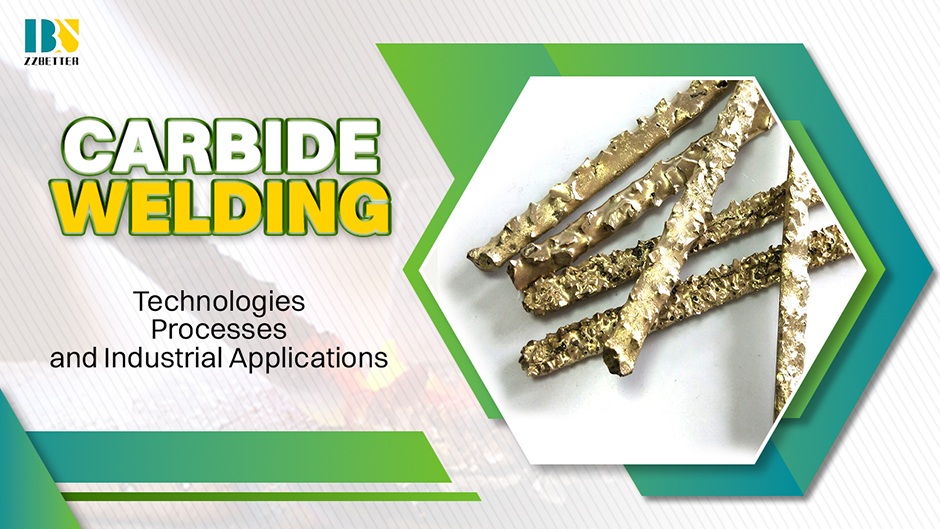
Cemented carbide, renowned for its exceptional hardness (up to 90 HRC) and wear resistance, is widely integrated into cutting tools, mining bits, and precision components via welding. However, its high brittleness and mismatched thermal expansion coefficient (TEC) with steel substrates (4–7 × 10⁻⁶/°C vs. 11–13 × 10⁻⁶/°C) pose unique welding challenges. This article details the dominant welding technologies, critical process controls, and real-world applications for carbide materials.
1. Dominant Welding Technologies for Carbide
Two methods prevail in industrial carbide joining: brazing (conventional yet reliable) and laser welding (advanced precision solution). Their core characteristics are compared below:
▶ Brazing: The Workhorse of Carbide Tool Manufacturing
Brazing achieves bonding by melting a filler metal (lower melting point than carbide/steel) to wet and fill joint gaps, without melting the base materials. It is the primary technique for carbide tools due to its cost-effectiveness and compatibility with mass production.
Key Principles & Filler Selection
Bonding Mechanism: Molten filler metal infiltrates micro-gaps via capillary action, forming metallurgical bonds with carbide (WC-Co) and steel substrates through element diffusion (e.g., Cr in filler reacts with C in carbide to form Cr₃C₂).
Filler Alloys:
Ni-Cr-Based: Preferred for high-temperature applications (e.g., milling tools), melts at 1050–1150°C, and offers excellent oxidation resistance.
Ag-Cu-Based: Used for low-stress tools (e.g., lathe inserts), melts at 650–800°C, reduces thermal shock risk.
Cu-Based: Economical choice for general-purpose cutting tools, requires flux to remove oxide films.
▶ Laser Welding: Precision Joining for High-Performance Tools
Laser welding uses a focused beam (1.06μm fiber laser preferred) to create localized molten pools, enabling high-strength, low-deformation joints. It is ideal for micro-tools and complex geometries.
Technical Advantages Over Brazing
Minimal Thermal Impact: Heat-affected zone (HAZ) < 0.5mm, reducing carbide cracking risk by 40%.
Rapid Processing: Welding speed up to 50mm/s for carbide inserts, 3x faster than induction brazing.
Filler-Free Option: Direct fusion for thin-walled carbide components (e.g., micro-drills).
2. Core Challenges & Mitigation Strategies
Carbide welding failures primarily stem from residual stress and poor wetting.
Targeted solutions are critical:
▶ Residual Stress & Cracking
Root Cause: TEC mismatch causes thermal contraction differences during cooling, generating tensile stress in carbide.
Solutions:
Use intermediate buffer layers (e.g., Ni-Cu alloy) to absorb stress.
Adopt stepwise heating/cooling (ramp rate ≤10°C/s) in induction brazing.
Post-weld tempering at 250°C for 2 hours to relieve stress by 30–50%.
▶ Poor Wettability
Root Cause: Carbide’s high surface energy resists filler metal infiltration.
Solutions:
Pre-treat carbide with Cr powder to form a Cr₃C₂ bonding layer .
Use active fluxes (e.g., borax-based) to remove oxide films on steel substrates.
▶ Filler Metal Erosion
Root Cause: Excessive heating dissolves carbide’s Co binder, weakening the joint.
Solutions:
Limit welding time to<60s for induction brazing.
Control laser pulse duration (2–5ms) to avoid prolonged exposure.
3. Industrial Applications & Case Studies
Carbide welding enables high-performance tools across sectors:
▶ Cutting Tools Manufacturing
CNC Tool Inserts: Induction brazing of WC-Co inserts to steel shanks using Ni-Cr-B-Si filler (1080°C, 45s) achieves 200MPa joint strength—withstanding 5000rpm machining loads.
Circular Saw Blades: Automated laser welding (300W fiber laser) of carbide teeth to steel discs reduces tooth breakage rate by 60% vs. brazing.
▶ Mining & Construction
Rock Drilling Bits: Vacuum brazing of carbide buttons to steel bodies (Ni-Cr filler, 1120°C) ensures resistance to 50MPa impact loads; service life extended by 2–3x.
▶ Precision Engineering
Micro-Machining Tools: Fiber laser welding of 0.8mm carbide tips to stainless steel shafts (250W, 15mm/s) maintains ±0.01mm dimensional accuracy for semiconductor wafer cutting.
4. Future Trends
Hybrid Welding: Combining laser pre-heating with induction brazing to reduce carbide cracking in thick-section joints.
Active Filler Development: Ni-Cr-Ti fillers that form stronger TiC bonds with carbide, improving joint durability by 30%.
Automation Integration: AI-driven systems with real-time thermal monitoring to optimize welding parameters for variable carbide grades.
Conclusion
Carbide welding demands a balance of material science and process control—brazing excels in cost-efficient mass production, while laser welding dominates precision-critical applications. By addressing residual stress and wettability challenges, manufacturers can unlock carbide’s full potential in high-wear, high-stress environments, from industrial machining to extreme mining operations.