

High Rigidity, High Precision, High Lifespan: The Three Core Advantages of Solid Tungsten Carbide Circular Saw Blades

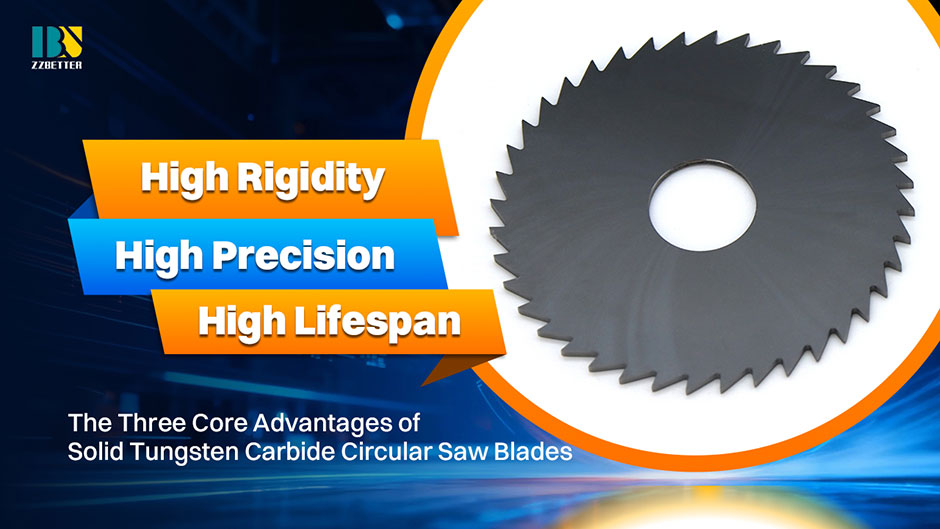
In the field of modern precision manufacturing, the performance of cutting tools directly determines product quality, efficiency, and cost. Among numerous cutting solutions, solid tungsten carbide circular saw blades have become the preferred choice for demanding machining applications due to their exceptional overall performance. Their unshakable market position is firmly built upon three core advantages: High Rigidity, High Precision, and High Lifespan. These three interdependent pillars form their unmatched competitiveness in challenging machining environments.
I. High Rigidity: The Foundation of Extreme Stability
Rigidity is a core indicator measuring a tool's ability to resist deformation under cutting forces. Solid carbide circular saw knives are monolithically formed from high Young's modulus tungsten carbide material via powder metallurgy processes, granting them structural integrity superior to traditional steel-bodied brazed carbide tips TCT) saw blades.
- Vibration and Chatter Suppression: When cutting high-strength or anisotropic materials (like carbon fiber composites, high-silicon aluminum alloys), significant cutting resistance can easily induce tool vibration. The ultra-high rigidity of solid carbide blades effectively suppresses this chatter, thereby preventing issues like rough cut surfaces, workpiece chipping (e.g., PCB delamination, carbon fiber fraying), and abnormal noise. A stable cutting process is the primary prerequisite for achieving a perfect cut.
- Enabling Micro-Machining and Deep Groove Cutting: For blades with very small diameters (e.g.,<3mm), only solid carbide material provides sufficient bending strength in an overhanged state to prevent deflection or breakage under lateral forces. Furthermore, in deep groove cutting, high rigidity ensures the tool remains stable under long overhang conditions without "deflecting," guaranteeing consistent slot width from top to bottom.
★ High rigidity is the physical foundation for achieving high precision and a long lifespan.
II. High Precision: The Guarantee of Micron-Level Consistency
The essence of precision machining lies in "reproducibility" – ensuring that thousands of cuts remain consistently within strict tolerances. Solid carbide circular saw blades excel remarkably in this aspect.
- Extremely Low Radial Runout: Benefiting from excellent material homogeneity and manufacturing processes, solid carbide blades maintain very low radial runout during high-speed rotation. This means the cutting path of each tooth is highly consistent, resulting in kerf or slot widths controllable to micron-level tolerances, fully meeting the stringent dimensional requirements of fields like precision electronics and medical devices.
- Superior Thermal Stability: The coefficient of thermal expansion of carbide material is significantly lower than that of steel. During high-speed dry cutting or interrupted cuts generating substantial heat, the blade's own dimensional change is minimal. This thermal stability ensures consistent cutting dimensions from the initial "cold state" at startup to the stable "hot state" during operation, achieving perfect consistency between the first and last parts in a production batch.
★ High precision is the critical bridge transforming superior design into reliable products.
III. High Lifespan: The Core of Total Cost Optimization
Tool lifespan directly impacts production line downtime, machining efficiency, and overall cost. Through their exceptional wear resistance, solid carbide circular saw blades create significant lifecycle value for users.
- Overall Wear Resistance, Multiplied Lifespan: Unlike TCT blades where only the teeth are tungsten carbide, the entire body and teeth of solid blades wear equally slowly. This not only ensures lasting performance when cutting highly abrasive materials (like graphite, fiberglass, composite boards) but also means they can undergo multiple high-quality regrinds. After each resharpening, the blade body's performance remains intact, resulting in a total service life far exceeding that of traditional blades.
- Withstanding Higher Cutting Parameters, Boosting Efficiency: The combination of high rigidity and high wear resistance allows solid carbide saw blades to utilize higher spindle speeds and feed rates, significantly increasing machining throughput. When processing difficult-to-machine materials, they maintain sharpness for extended periods, avoiding issues like skyrocketing cutting forces, heat accumulation, and workpiece surface burn caused by a dull tool, thereby safeguarding production rhythm and product quality stability.
★ A long lifespan is the solid foundation for achieving cost reduction, efficiency gains, and unmanned smart production.
In summary, high rigidity, high precision, and high lifespan are not isolated benefits but form a powerful virtuous cycle: High rigidity enables high precision and reduces the risk of chipping caused by vibration, thereby extending lifespan. The stable cutting of high precision avoids abnormal loads, protecting the tool. A long lifespan ensures that high precision can be sustained over time.
In cutting-edge fields such as PCB depaneling, aerospace composite machining, and precision mold manufacturing, these three advantages work in concert, transforming solid tungsten carbide round saw blades from simple consumables into strategic tools that push process limits, guarantee product quality, and optimize production efficiency. Choosing them means choosing reliability, accuracy, and efficiency.