

How to Avoid Deformation and Burrs in High-Efficiency Machining with tungsten Carbide Saw knives

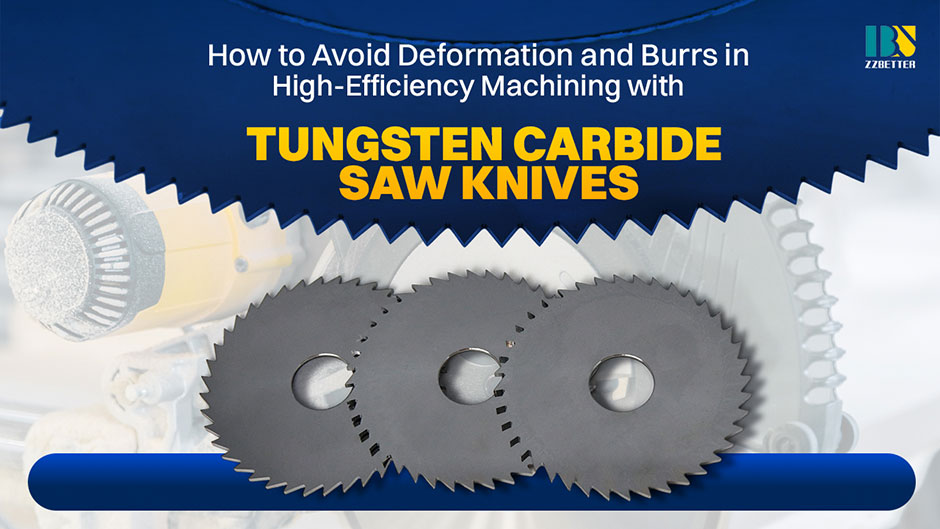 In modern manufacturing, solid carbide saw blades have become key tools for high-efficiency machining due to their excellent characteristics such as high rigidity, high precision, and long service life. However, while pursuing machining efficiency, how to effectively prevent workpiece deformation and burr formation presents a common challenge for many manufacturers. This article will provide an in-depth analysis of the mechanisms behind deformation and burr formation and propose systematic solutions.
I. Analysis of Deformation and Burr Formation Mechanisms
1. Root Causes of Workpiece Deformation
- Thermal Stress Deformation: Heat generated during the cutting process causes localized temperature rise in the workpiece, leading to uneven thermal expansion and contraction.
- Mechanical Stress Deformation: Excessive or unevenly distributed cutting forces cause elastic or plastic deformation of the workpiece.
- Clamping Stress Deformation: Improper fixture design or inappropriate clamping force alters the initial stress state of the workpiece.
- Residual Stress Relief: Internal residual stresses within the workpiece redistribute during machining.
2. Mechanisms of Burr Formation
● Exit Tear Burrs: Material tears due to plastic deformation at the cut exit point.
● Side Burrs: Relative vibration between the tool and workpiece prevents complete material removal.
● Feed-Induced Burrs: Improper feed rates cause material to be挤压 instead of cleanly sheared.
● Tool Wear Burrs: Dulled cutting edges fail to effectively sever material fibers.
II. Systematic Solutions
1. Tool Optimization Design Strategy
- Geometry Parameter Optimization:
● Utilize variable helix angle designs to distribute cutting force fluctuations.
● Optimize the combination of rake angle (10°-15°) and clearance angle (8°-12°).
● Design adequate chip gullet space and efficient chip evacuation channels.
- Edge Preparation Technology:
● Apply micro-beveling to enhance edge strength.
● Utilize nano-level edge honing technology.
● Implement differentiated edge reinforcement strategies.
2. Precise Control of Machining Parameters
- Cutting Parameter Optimization:
● Maintain a constant feed per tooth (0.05-0.15 mm/z).
● Control cutting speed within the recommended range.
● Employ gradual engagement and disengagement strategies.
- Path Planning Optimization:
● Adopt adaptive layer cutting strategies.
● Implement optimized finishing paths.
● Use intelligent corner handling techniques.
3. Enhancement of Process System Rigidity
- Machine Tool Selection:
● Select machining centers with high rigidity and precision.
● Ensure spindle radial runout < 0.005 mm.
● Maintain accuracy stability of guides and ball screws.
- Fixture Optimization:
● Employ vacuum chucks or dedicated workholding.
● Design multi-point balanced clamping systems.
● Use flexible support elements.
4. Cooling and Lubrication Strategy
- Cooling Method Selection:
● High-pressure through-tool coolant systems (pressure ≥ 8 MPa).
● Precise positioning of coolant jets.
● Application of Minimum Quantity Lubrication (MQL) technology.
- Cutting Fluid Optimization:
● Select specially formulated cutting fluids.
● Maintain cutting fluid concentration and cleanliness.
● Regularly monitor and replace cutting fluids.
III. Targeted Solutions for Specific Materials
1. Thin-Walled Part Machining
● Employ low-stress cutting strategies.
● Implement symmetrical alternating machining sequences.
● Use auxiliary support fixtures.
● Control depth of cut and feed rate.
2. Composite Material Machining
● Select specialized diamond-coated saw blades.
● Adopt high-frequency vibration-assisted cutting.
● Control cutting force and temperature.
● Optimize fiber orientation and layup direction considerations.
3. Non-Ferrous Metal Machining
● Use sharp edges with high rake angles.
● Employ polished chip gullets.
● Control the ratio of cutting speed to feed rate.
● Implement adequate cooling and lubrication.
IV. Advanced Monitoring and Control Technologies
1. Online Monitoring Systems
● Real-time cutting force monitoring and feedback control.
● Acoustic emission signal analysis technology.
● Infrared thermal imaging temperature monitoring.
● Vibration signal spectrum analysis.
2. Intelligent Control Systems
● Adaptive control systems.
● AI-based process parameter optimization.
● Digital twin technology applications.
● Cloud-based data monitoring and analysis.
V. Typical Case Analysis
A precision electronics company faced severe burr issues when machining aluminum alloy housings. The following improvements were implemented:
1. Switched to a specialized aluminum alloy saw blade (20° rake angle, 15° clearance angle).
2. Optimized cutting parameters: 280 m/min cutting speed, 0.08 mm/tooth feed.
3. Adopted a high-pressure coolant system (10 MPa pressure).
4. Implemented a tool life management system.
Improvement Results:
● Burr occurrence reduced by 95%.
● Machining efficiency increased by 35%.
● Tool life extended by 2.5 times.
● Product qualification rate reached 99.8%.
VI. Preventive Maintenance and Management
1. Tool Management System
● Establish tool service life records.
● Implement regular inspection and maintenance schedules.
● Utilize tool presetters to ensure accuracy.
● Establish tool retirement criteria.
2. Process Stability Control
● Implement Statistical Process Control (SPC).
● Create a process parameter database.
● Conduct regular equipment accuracy inspections.
● Provide professional training for operators.
Avoiding deformation and burrs in machining with solid carbide saw blades requires systematic optimization across multiple dimensions, including the tool, process, equipment, and material. Through scientific tool design, precise control of process parameters, reliable process system rigidity, and effective cooling and lubrication strategies, machining quality can be significantly improved. In the future, with the development of smart manufacturing technologies, real-time monitoring, data analysis, and intelligent control will enable more precise control of the machining process, further enhancing efficiency and quality stability. Manufacturing enterprises should establish comprehensive quality control systems and continuously optimize machining processes to meet increasingly demanding quality requirements.