

Carbide Nozzle Scenario Application Type Adaptation and Value Realization

Carbide Nozzle Scenario Application Type Adaptation and Value Realization
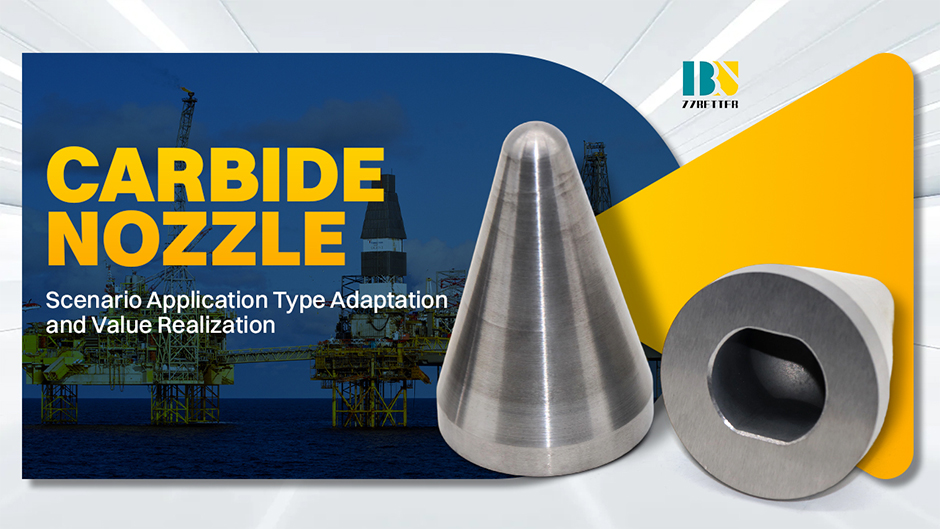
Carbide nozzles are precision components made by sintering hard carbide materials (primarily tungsten carbide, WC) with metal binders (such as cobalt, Co). Boasting a Vickers hardness of over 1300 HV, excellent wear resistance (10-20 times higher than high-speed steel), and strong thermal stability, they have become irreplaceable core parts in sectors like industrial processing, energy, and electronics. The key to maximizing their application value lies in precise scenario-type adaptation—matching the right nozzle type to specific working conditions to balance performance, durability, and cost-effectiveness.
In abrasive jet processing scenarios, including sandblasting for surface rust removal and high-pressure water jet cutting of metal plates, the nozzle inner wall is continuously impacted and abraded by high-speed (up to 800 m/s) abrasive particles (e.g., alumina, silicon carbide). For this, fine-grain carbide nozzles (with a tungsten carbide grain size of 0.5-1μm) are the optimal choice. Their ultra-dense microstructure minimizes the penetration of abrasive particles, reducing inner wall wear rate significantly—extending service life by 3-5 times compared to traditional ceramic nozzles and cutting down on frequent replacement downtime.
For high-temperature industrial scenarios such as metal smelting flue gas purification and waste incineration exhaust treatment, nozzles must withstand long-term exposure to 800-1000℃ high temperatures while maintaining airflow stability. Here, tungsten-cobalt carbide nozzles (with a cobalt binder content of 6%-8%) perform exceptionally well. The cobalt binder forms a stable bond with tungsten carbide grains, preventing structural cracking caused by thermal shock and ensuring consistent spray atomization effect, which is crucial for efficient flue gas desulfurization and dust removal.
In precision fluid delivery fields like semiconductor chip cleaning and LCD panel coating, even minimal fluid turbulence can lead to micro-defects (e.g., 0.1μm-scale scratches) on product surfaces. Polished carbide nozzles—with an inner wall surface roughness of Ra≤0.02μm (achieved through 12-stage precision grinding)—eliminate fluid eddies, enabling uniform spray coverage (with a deviation of less than 5%) and meeting the ultra-high precision requirements of the semiconductor industry.
For heavy-duty mining environments (e.g., coal mine underground dust suppression and mineral processing pipeline transportation), nozzles face dual challenges: mechanical collision from coal/rock fragments and corrosion from mineral-rich water. Thick-walled carbide nozzles (with a wall thickness of 5-8mm, 2-3 times that of standard nozzles) and a surface anti-corrosion coating (e.g., chromium plating) solve this problem. They reduce replacement frequency by over 60% compared to ordinary steel nozzles, lowering maintenance costs for mining enterprises.
The value realization of carbide nozzles stems from this deep scenario-type synergy. By tailoring material formulas (e.g., adjusting cobalt content), structural designs (e.g., thickening walls), and precision processing (e.g., ultra-fine polishing) to specific industry needs, they not only cut down maintenance costs by 30%-50% and improve production efficiency by 20%-30% but also support technological breakthroughs in high-end fields—such as aerospace engine component cutting (requiring nozzles with a dimensional accuracy of ±0.005mm). As industries like new energy, semiconductors, and aerospace pursue higher performance standards, scenario-oriented customization of carbide nozzles will further unlock their potential, becoming a key driver for industrial upgrading and high-quality development.