

Carbide Gun Drill VS Ordinary Drill Bit

Carbide Gun Drill VS Ordinary Drill Bit
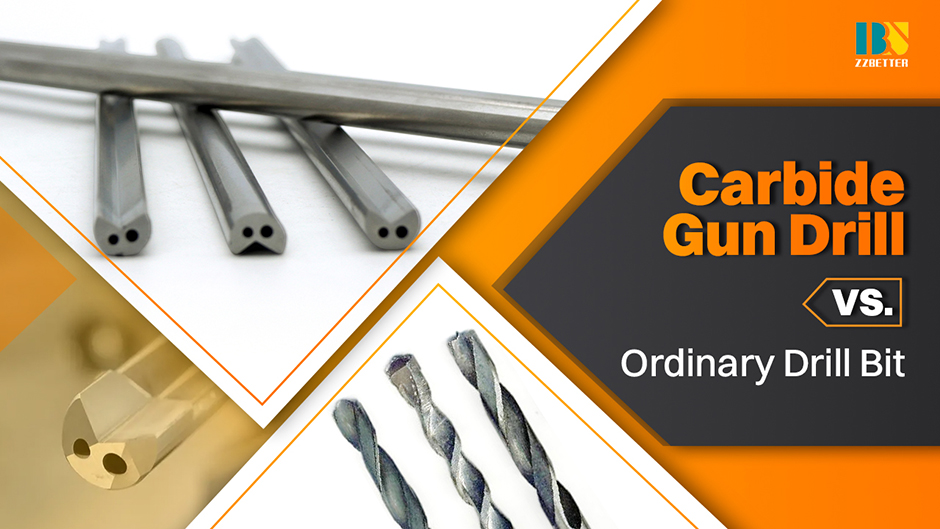
In the field of mechanical machining, drilling is one of the most common processes. However, when faced with deep hole drilling, ordinary drill bits often fall short, while carbide gun drills become the professional choice. This article will detail the core differences between the two to help you make the right decision for your machining tasks.
1. Difference in Structure and Design
Ordinary drill bits have a simple structure, typically made of high-speed steel, relying on a tip and two chip flutes for cutting and chip evacuation. Their overall rigidity is weak, making them prone to deflection and vibration when drilling deep.
The carbide gun drill is a precision composite tool. It uses a high-hardness carbide tip mounted on a seamless steel tube shank. The gun drill is internally designed with a high-pressure coolant channel and features a single cutting edge. Its unique V-shaped flute design ensures both drilling accuracy and efficient cooling and chip evacuation.
2. Direct Comparison of Machining Capability and Performance
▶▷ Hole Depth and Precision:
Ordinary Drill Bit: Typically used for drilling shallow holes with a depth less than 5 times the diameter. When drilling deep holes, it easily deviates from the center, has poor straightness, and unstable bore diameter dimensions.
Carbide Gun Drill: Designed specifically for deep hole drilling, easily handling holes dozens or even hundreds of times the diameter in depth. It guarantees extremely high hole straightness, dimensional accuracy, and surface finish.
▶▷ Cooling and Chip Evacuation:
Ordinary Drill Bit: Coolant is applied externally, struggling to reach the deep tip. Chip evacuation is difficult, easily leading to drill bit wear and chip clogging.
Carbide Gun Drill: High-pressure coolant is injected directly onto the cutting zone internally, forcibly ejecting chips through the V-shaped flute. This not only effectively cools the tip but also prevents chips from scratching the finished surface.
▶▷ Efficiency and Cost:
Ordinary Drill Bit: Low initial purchase cost, but inefficient for deep hole drilling, requiring frequent retraction for chip clearing. Fast tool wear means the overall cost is not necessarily low.
Carbide Gun Drill: Enables one-pass, continuous machining with extremely high efficiency. Although the unit cost is high, its exceptional durability and machining quality significantly reduce the per-part cost in mass production.
3. Clear Division of Application Scenarios
Ordinary Drill Bit: A common tool in general workshops, suitable for applications with low requirements for precision and depth, such as bolt clearance holes and assembly positioning holes.
Carbide Gun Drill: Widely used in fields with stringent requirements for deep hole quality, such as automobile engine oil passages, hydraulic valve bodies, aerospace components, and medical devices.
Conclusion
In summary, ordinary drill bits and carbide gun drills are not simple substitutes but complementary. The ordinary drill bit is an economical "all-rounder," while the carbide gun drill is a "specialized scalpel" for solving deep hole machining challenges. When choosing, be sure to base your decision on your specific machining needs—hole depth, precision, efficiency, and budget—to achieve the best machining results and economic benefits.