

Comprehensive Comparison Between Carbide Burrs and High-Speed Steel Burrs

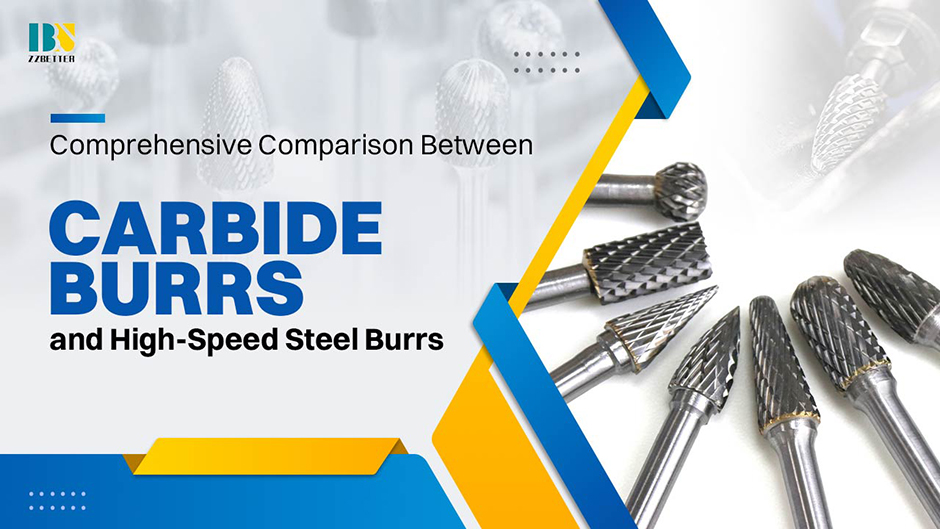
In the field of mechanical processing, the choice of tool material directly affects processing efficiency, cost, and product quality. Carbide burrs and High-Speed Steel burrs, as two common types of cutting tools, each possess unique performance characteristics and suitable application scenarios.
In modern mechanical processing, mold manufacturing, and part finishing, burrs are widely used as efficient cutting tools. Among them, Carbide Burrs and High-Speed Steel Burrs are the two main types. They each play important roles under different processing conditions, leveraging their distinct material properties and performance advantages. Understanding their differences is crucial for selecting the most appropriate processing tool, improving production efficiency, and reducing production costs.
1. Material Composition and Basic Characteristics
Carbide Burrs are powder metallurgy products sintered in vacuum or hydrogen reduction furnaces. Their main components are micron-sized powders of high-hardness, refractory metal carbides (WC, TiC), using cobalt or nickel, and molybdenum as binders.
This material composition gives them characteristics of high hardness, high wear resistance, and high-temperature resistance, with a processing hardness capable of reaching HRA ≥ 85.
High-Speed Steel Burrs are made from high-quality high-speed alloy steel material. Although the search results do not provide detailed composition, based on general tool knowledge, high-speed steel is a high-carbon steel containing alloying elements such as tungsten, molybdenum, chromium, and vanadium. It can achieve relatively high hardness and wear resistance through heat treatment.
However, compared to carbide, high-speed steel has lower hardness and wear resistance but better toughness.
2. Hardness and Wear Resistance Comparison
In terms of hardness and wear resistance, carbide burrs are significantly superior to high-speed steel burrs.
Carbide burrs exhibit excellent wear resistance, with a service life 10 times longer than that of high-speed steel burrs.
This superior wear resistance allows carbide burrs to process various metals (including hardened steel) below HRC70 and non-metallic materials (such as marble, jade, bone).
In contrast, high-speed steel burrs wear out relatively quickly when processing high-strength materials like hardened steel, resulting in a comparatively shorter service life.
3. Service Life and Economy
Regarding service life, carbide burrs hold a significant advantage. They are not only 10 times more durable than high-speed steel burrs but also over 200 times more durable than aluminum oxide grinding wheels.
This extended service life means the comprehensive processing cost of carbide burrs can be reduced by tens of times.
Although the initial procurement cost of carbide burrs may be higher than that of high-speed steel burrs, their longer service life translates to fewer tool changes and more stable processing quality, offering significant overall economic benefits from a long-term usage perspective.
4. Processing Efficiency Comparison
In terms of processing efficiency, carbide burrs also demonstrate outstanding performance. Their production efficiency is dozens of times higher than that of hand files and nearly 10 times higher than that of small mounted grinding wheels.
Carbide burr have a high hardness (up to 86–93 HRA), far exceeding that of high-speed steel (approximately 62–70 HRA). Therefore, when machining high-hardness materials (such as stainless steel, high-temperature alloys, and hardened steel), they maintain a sharper cutting edge, achieving higher cutting speeds and longer service life, thus improving overall machining efficiency. High-speed steel burr, while having better toughness, has lower hardness and is prone to wear during high-intensity continuous cutting, resulting in relatively lower efficiency.
5. Applicable Processing Range
Carbide burrs can process a wide range of metallic materials, including cast iron, cast steel, carbon steel, alloy steel, stainless steel, hardened steel, copper, and aluminum, as well as non-metallic materials like marble, jade, and bone.
Their wide range of applications leads to notable usage effects in industries such as machinery, automotive, shipbuilding, chemical, and artistic carving.
Main uses include: precision finishing of various metal mold cavities; cleaning flash, burrs, and welds on cast, forged, and welded components; chamfering, rounding, and grooving of various mechanical parts; and finishing the flow channels of impellers.
High-speed steel burrs are more suitable for processing ordinary strength materials and application scenarios requiring higher tool toughness.
6. Operational Requirements and Precautions
Carbide burrs are primarily driven by electric or pneumatic tools (can also be mounted on machine tools), with a rotational speed generally between 6000 and 40000 RPM.
During use, the tool must be clamped tightly and correctly. The cutting direction should move uniformly from right to left; avoid reciprocating cutting, and do not apply excessive force.
During operation, avoid applying too much pressure when the grinder's speed decreases, as this can cause the burr to overheat and blunt easily.
Promptly replace or reground dull burr heads to prevent complete destruction.
In comparison, the operational requirements for high-speed steel burrs may not be as strict as for carbide burrs, but due to their poorer wear resistance, they may require more frequent replacement or regrinding.
Conclusion and Selection Suggestions
In summary, carbide burr have significant advantages in high-efficiency, high-hardness, and high-temperature working conditions, while high-speed steel burr are more advantageous in terms of economy, toughness, and versatility. The two should be selected rationally according to specific processing requirements.
When selecting burrs, it is necessary to comprehensively consider factors such as processed material, precision requirements, production batch size, and cost budget to choose the most suitable tool type, thereby achieving optimal processing results and economic benefits.