

Core Maintenance Guide for Extending Gun Drill Lifespan and Precision

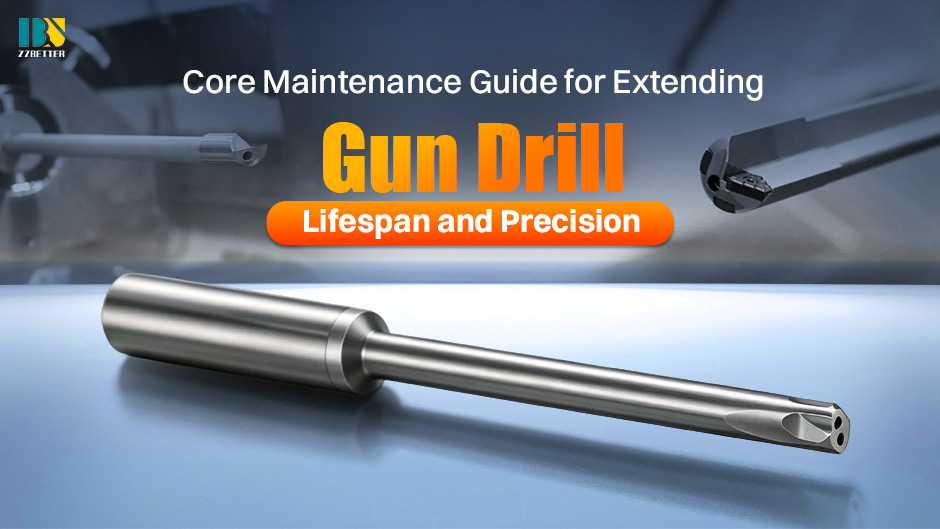
Carbide gun drills are core precision tools for deep hole machining. Investing in correct maintenance methods can not only effectively extend their service life but also ensure long-term stable machining accuracy and surface quality, thereby achieving higher machining economy. The following is a set of systematic and practical maintenance guidelines.
I.Precise Start: Ensuring Installation and Initial Alignment
1. Correct installation is the foundation for realizing gun drill performance; even minor deviations can lead to premature tool failure.
2. Use high-precision tool holders: Always use hydraulic tool holders or shrink-fit tool holders for clamping to ensure sufficient rigidity and concentricity.
Strictly control runout: Measure the radial runout of the gun drill at the spindle nose; it is recommended that the full-length runout value does not exceed 0.02 mm.
3. Perform precise alignment: Before machining, it is essential to use an edge finder to ensure the tip of the gun drill is perfectly aligned with the pre-drilled hole or starting surface on the workpiece.
II.Meticulous Management of the Coolant System
1. High-pressure coolant is the lifeline of a gun drill, and its condition directly determines chip evacuation effectiveness and internal hole quality.
2. Ensure pressure and flow rate: Strictly adhere to technical parameters, typically requiring 70 to 150 bar of pressure to ensure effective chip removal.
3. Maintain high cleanliness: Use a high-precision filtration system to promptly remove metal fines from the coolant to prevent clogging of oil holes.
4. Regularly monitor condition: Periodically check and adjust the concentration and pH of the coolant to prevent corrosion of the drill shank and ensure lubrication performance.
III. Application of Scientific Machining and Chip Breaking Strategies
Reasonable cutting parameters and strategies are key to protecting the tool and avoiding abnormal wear.
1. Follow recommended parameters: Select appropriate rotational speed and feed rate based on the characteristics of the workpiece material; avoid blindly using excessively high parameters.
2. Program chip breaking cycles: For tough materials, program regular peck drilling or retraction actions to achieve effective chip breaking.
3. Listen to the machining sound: A steady cutting sound indicates normal operation; if abnormal noise or vibration occurs, stop the machine immediately for inspection.
IV. Adherence to Daily Maintenance and Inspection Protocols
Preventive maintenance can minimize unplanned downtime and tool damage to the greatest extent.
1. Clean immediately after use: After each machining operation, thoroughly clean the gun drill's flutes and internal channels using an air gun and specialized brushes.
2. Regularly inspect wear condition: Use magnification tools to inspect the wear land on the tool's flank face. When uniform wear reaches approximately 0.3 mm, arrange for regrinding.
3. Entrust to professional regrinding services: Worn gun drills should be sent to service providers possessing original drawings and technology for regrinding and recoating to restore performance.
By combining precise installation, coolant management, parameter optimization, and daily maintenance into a standardized operational procedure, you can fully unlock the machining potential of gun drills, achieving improved precision alongside better long-term usage benefits.